
Description
Insulin sensitivity and fat loss signals
Insulin sensitivity is not about fearing food. It is about whether a normal meal clears cleanly or hangs around long enough to keep storage pressure high.
When it slips, fat loss starts to feel random. The same discipline can produce a different outcome because the internal margin for error gets smaller.
This pdf includes supporting content you can purchase and revisit on demand, so your decisions stay consistent when motivation is not the issue.
Why the waistline gets louder after 35
After 35, hormones and recovery trends shift for many lifters. The waistline often tells the truth first because it is where stubborn fat shows up when food handling gets noisier.
Visceral fat matters here. When it builds around the midsection, it can act like a metabolic loudspeaker that makes the whole system harder to manage over time.
That is why the issue can feel bigger than dieting. It is not only about fat loss. It is about the signals that drive hunger, energy, and storage.
Muscle, training consistency, and carb tolerance
Muscle is one of the main destinations for glucose. When training gets inconsistent and muscle slowly drops, the same meals can hit harder because capacity is lower.
We see this most in experienced lifters who still train hard, but who have less room for sloppy recovery, less forgiving sleep, and higher background stress.
This is not about doing more. It is about understanding what changes the response, so effort stops being the only lever you pull.
Walking, steps, and post meal context
Many lifters underestimate how much daily activity changes with age. When walking and steps slide outside the gym, the system often becomes less predictable even if training stays serious.
The same is true when post meal movement disappears from normal life. The consequence is usually more swings, more cravings, and less reliable feedback from the mirror.
When lab markers add context without drama
If you already have lab work, markers like fasting glucose and triglycerides can add context. They do not replace judgment, and they should never become a label.
We treat them as optional information that can support a calmer conversation with a qualified clinician, especially when fatigue, recovery, or waist gain start to cluster together.
Nutrition decisions without extremes
Extreme rules fail advanced lifters because they ignore context and tradeoffs. When insulin sensitivity is the constraint, food quality, protein, fiber, and carb use stop being ideology and become decision points.
If nutrition is already the bottleneck for your progress, this pairs naturally with our Bodybuilding Nutrition and the Nutrition Blueprint pdf when you want a broader reference without losing reality.
If you are past beginner advice and you want clear perspective on why fat loss and the waistline respond differently now, this pdf will meet you where you are and support better decisions over time.
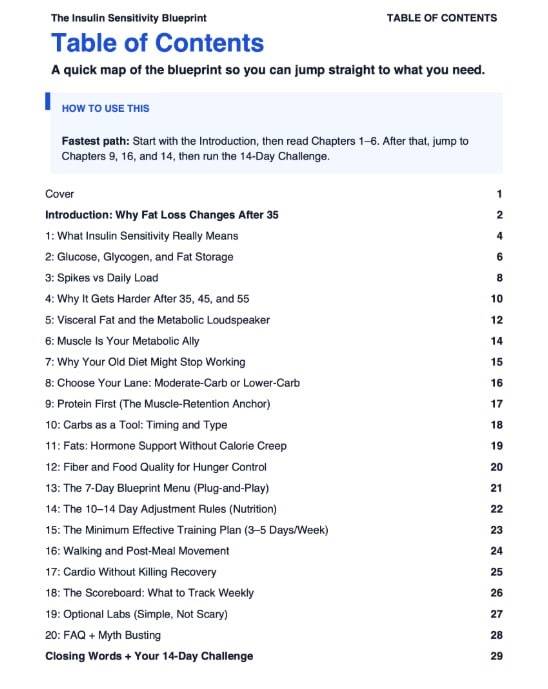
Table of content
- Introduction and Foreword
- GLP-1s in plain English (what they do to appetite, digestion, glucose)
- The 3 priorities: protein, fiber, hydration (what to hit first)
- The “small-meal” structure (when big plates backfire)
- Side-effect food playbook (nausea, constipation, reflux, diarrhea)
- Protein targets + easiest formats when appetite is low
- Strength training: the minimum dose to keep muscle
- Steps + post-meal walks: the low-fatigue accelerator
- The 7-day GLP-1 menu (3 appetite levels: low/medium/high)
- The 14-day adjustment rules (your signature, GLP-1 edition)
- Coming off meds / maintenance (how not to rebound)
- FAQ + myth busting + “talk to your clinician” guardrails
- Final Thoughts
Disclamer
This pdf is informational only and does not replace individualized guidance from a qualified professional. Training and nutrition involve risk and outcomes vary between individuals. By using this pdf, you accept responsibility for your own decisions and agree to seek professional support when appropriate.
Reviews
There are no reviews yet.